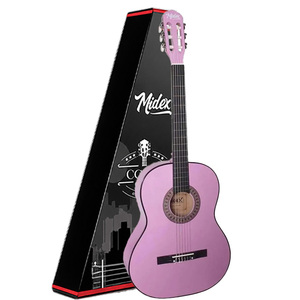
Acoustic Series
Explore production-ready platforms engineered to deliver optimal structural tension resistance, refined acoustic projection, and scalable production stability.
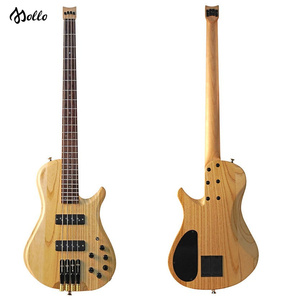
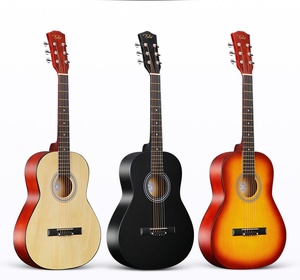
A rigorous evaluation framework for category managers, distribution leads, and musical instrument brand owners procuring professional-grade instruments globally.
Standard 6-string acoustic sets exert roughly 150 to 170 pounds of pull against the soundboard. In a tuned 12-string arrangement, this vector jumps exponentially to 240 to 260 pounds of total force.
Leading exporters integrate engineered forward-shifted X-bracing with graphite reinforcement and twin dual-action truss rod systems to prevent soundboard bellying, bridge lift, or rotational neck warping over multi-year logistics storage cycles.
The tonal magic of a 12-string rests on pairing standard octave strings (E, A, D, G) and unison pairs (B, high E). Sub-par factories fail at the nut slotting stage, causing octave pitch buzzing and thumb fatigue.
High-tier manufacturing utilizes automated 5-axis CNC diamond-ground nut cutters to calibrate course gaps down to 2.1mm spacing with graduated depth, delivering comfortable low action without parasitic string rattles across the first three frets.
Exporting to diverse climatic zones (such as Scandinavia versus the Gulf region) demands strict wood stabilization. Solid Sitka spruce tops and African mahogany necks require continuous radio-frequency vacuum kiln-drying to achieve 8% equilibrium moisture content (EMC).
Exporters lacking controlled humidity clean-rooms encounter seam splits and fret sprouts during sea freight container transits through equatorial routes.
Strategic purchasing vectors, material shifts, and electronic innovations dominating international import tenders for 2026 and beyond.
Standard under-saddle piezo elements traditionally struggle with the dynamic dispersion of 12 vibrating strings, frequently yielding a brittle, compressed frequency spike in live performance.
The latest procurement shift incorporates dual-source mic/under-saddle transducers and internal phase-inversion EQ boards designed to cleanly balance the octave shimmer without muddying lower midrange chords.
Strict CITES regulations and shifting consumer sustainability expectations have prompted tier-1 exporters to deploy thermally modified (torrefied) domestic maple, Laurel, and richlite fingerboards.
Torrefaction crystalizes remaining hemicellulose in the timber cell structure, mimicking decades of natural acoustic aging while boosting resistance against ambient atmospheric humidity shifts.
Stage touring acts increasingly seek slimline ergonomic electric-acoustic chambered bodies that curb microphonic feedback at higher sound pressure levels.
B2B importers are growing line allocations for semi-hollow and thinline chambered models featuring split magnetic/piezo outputs, offering versatile acoustic choral voices and driven electric tones in one stage-ready frame.
Combining the accountable heritage of established international guitar design with advanced industrial manufacturing capacity and global logistics reliability.
| Evaluation Parameter | Standard OEM Exporters | Our Manufacturing Ecosystem (JAM USA Standard) | Strategic Trade Benefit |
|---|---|---|---|
| Structural Integrity | Single generic truss rod, standard X-brace | Dual-action heavy-duty steel truss rods + dual carbon-fiber stabilizer spars | Zero neck twist returns; pristine long-term action reliability |
| Wood Seasoning | Open-air atmospheric drying (unregulated) | Controlled RF kiln drying with digital EMC monitoring (8–10%) | High resistance to humidity swings across international shipments |
| Nut & Bridge Precision | Manual hand-filing with high variance | Automated CNC slotting, precision compensated bone bridge saddles | Flawless intonation across all 12 fretted registers straight from box |
| Quality Governance | Random spot-check of 5% finished batch | 100% full-tension 48-hour mechanical tune-in bench stress testing | Sub-0.4% RMA warranty return rate for distributors worldwide |
| Supply Chain Scale | Fragmented artisan workshops | Institutional manufacturing lines backed by established brand governance | Guaranteed container delivery windows, consolidated billing, complete IP protection |
Direct technical and operational answers to address common queries raised during factory audits, sampling, and wholesale orders.
We deploy high-density laminated rosewood or laurel bridge plates coupled with automated high-frequency under-bridge heat press bonding. Titebond cross-linking adhesives are cured under computer-controlled pneumatic clamps, ensuring a shear strength rating that exceeds 3,000 PSI to resist intense upward string pull.
Our standard production MOQ for custom private-label series starts at 100 units for standard finishes, and 300 units for bespoke body shapes, custom headstock carves, or specialized proprietary pickup and preamp integrations. Mixed-container consolidations across 6-string and 12-string lines are fully supported.
Yes. Traditional 12-strings often feel overly bulky. Our engineering team utilizes optimized shallow "C" and modern "D" profiles with a 48mm nut width and a compound 12" to 16" fretboard radius, giving guitarists a comfortable hand feel without crowding string pairs.
We specify premium 18:1 high-ratio sealed die-cast tuning machines with minimal gear backlash. On electric models, we route straight-string-pull headstock geometries to minimize friction at the nut slots, pairing them with self-lubricating synthetic bone or graphite nuts.
Every instrument is detuned to half-step tension, enveloped in multi-layer moisture-barrier polybags with silica desiccants, anchored inside dual-wall 5-ply corrugated inner cartons, and palletized with corner-edge reinforcements and thermo-shrink shrinkwrap for full sea freight security.
All timbers employed in our production facilities are accompanied by legitimate origin certificates, Lacey Act declarations, and CITES non-endangered wood paperwork where applicable, ensuring hassle-free customs clearance into North American, EU, and Australasian ports.
From initial design sketches and 3D CAD modeling to rapid sample prototyping and high-capacity container manufacturing, our team delivers consistent quality, refined playability, and margin-healthy supply.
This site uses cookies to improve your browsing experience. To learn how cookies are used, please review our Privacy Policy. By clicking “I Agree” or continuing to use this site, you consent to this use.